Got net-zero news, project updates, or product launches to share?
 Wincanton’s Electric Trucks and TfL’s Zero‑Emission Buses Fuel UK Net‑Zero Transport Momentum

Welcome to Net Zero News, your daily briefing on the UK’s transition to a low‑carbon future.
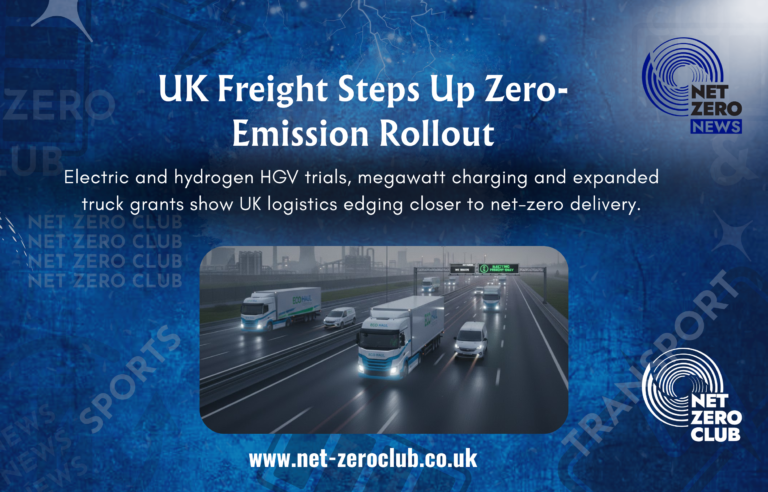
Wincanton, one of the UK’s leading supply‑chain firms, has announced the arrival of 24 new electric trucks supplied by DAF Trucks, Volvo Trucks and Renault Trucks. These heavy‑duty vehicles, each weighing over 40 tonnes, are projected to reduce the company’s carbon emissions by 2,400 tonnes per year. To support this electrification, Wincanton is deploying depot‑based charging infrastructure at key locations including Greenford, Portbury, Scotland Gateway Hub near Glasgow, and The WEB in Northamptonshire. The deployment is backed by partners Voltempo and Gridserve, and is part of the Electric Freightway and eFREIGHT 2030 consortia, which belong to the Zero Emission HGV and Infrastructure Demonstrator programme supported by the Department for Transport and Innovate UK.
Meanwhile, Transport for London (TfL) has achieved a major milestone: over 2,000 zero‑emission buses are now operating across the capital equating to around 20% of its fleet, up from just 30 buses in 2016. TfL aims to convert its entire bus network to zero‑emission by 2030. The initiative is estimated to reduce carbon emissions by five million tonnes over the next two decades. Further investment in this sector includes a £12 billion procurement from more than 3,000 UK suppliers, 30% of whom are in low‑carbon industries, and a five‑year partnership with Wrightbus to deliver an additional 75 zero‑emission vehicles in 2025 (generating green UK manufacturing jobs).
Grid capacity remains a critical barrier to the electrification of commercial vehicles, according to analysis from the Society of Motor Manufacturers and Traders (SMMT). Approximately 5.1 million vans and 626,000 trucks are on UK roads, with CVs contributing over a third of road transport CO₂ emissions and nearly 12% of the UK’s overall carbon footprint. Yet operators report waiting times of up to 15 years for grid connections at depots, hindering their transition to zero‑emission vehicles. Although over half of van models and more than 30 truck models are now zero‑emission, uptake lags behind mandates only 8.3% of new van registrations are ZEVs, and just 0.5% of trucks.
The Road Haulage Association (RHA) survey reveals that 70% of HGV operators and 75% of coach operators currently have no plans to add zero‑emission vehicles. Key barriers include limited eHGV range (45%), high purchase costs (38%), and reduced payloads due to battery mass (30%). Only 9% of HGV operators use electric trucks, although 14% intend to adopt them within five years, and 12% plan to explore hydrogen vehicles. The RHA is calling for urgent government interventions, including business financing, support for low‑ and no‑carbon fuels such as HVO, and knock‑on infrastructure investment including faster planning and grid access.
In Wales, the Zemo Partnership, in conjunction with the Welsh Government, is hosting “Moving to Zero – West Wales” on 25 February 2026. The event focuses on decarbonising industrial haulage, utilities fleets, ports, and logistics corridors sectors that are hardest to abate and vital to the region’s economy. Attendees will explore real‑world solutions for zero‑emission HGVs, pathways for legacy fleet transition, infrastructure planning, and green freight financing. Collaboration and coordinated planning are emphasised as essential to aligning fleet transition with energy infrastructure and policy frameworks.
What this means:
The UK’s push towards net‑zero transport continues to accelerate. Wincanton’s first electric trucks and TfL’s growing zero‑emission bus fleet demonstrate real‑world deployment of low‑carbon technologies that reduce emissions and deliver economic benefits. However, structural issues remain. Grid connection delays severely inhibit depot electrification, posing a systemic bottleneck—particularly for logistics operators and heavy‑duty freight. Meanwhile, awareness and uptake of zero‑emission technologies among operators remain limited without stronger incentives and support. The RHA’s warning and Zemo’s policy‑focused work highlight the need for coordinated government and industry responses to remove infrastructure and policy barriers. Targeted funding, accelerated grid access, regulatory clarity, hydrogen and low‑carbon fuel integration, and strategic planning will all be critical levers.
The West Wales event showcases how regional collaboration and multi‑stakeholder engagement can help unlock hard‑to‑abate transport segments. By aligning innovation, infrastructure, finance and policy, local action can scale solutions and support national net‑zero goals.
Upcoming Events:
Net Zero Scotland Projects Conference -16 June 2026, Edinburgh
Net Zero Nations Projects Conference – 6 October 2026, Westminster
Do you have technologies, innovations or solutions that can help public‑sector net‑zero projects?
Email: lee@net-zero.scot