Got net-zero news, project updates, or product launches to share?
 UK Freight Goes Green: Electric HGVs, Infrastructure and Low‑Carbon Fuels

Welcome to Net Zero News, your daily briefing on the UK’s transition to a low‑carbon future.
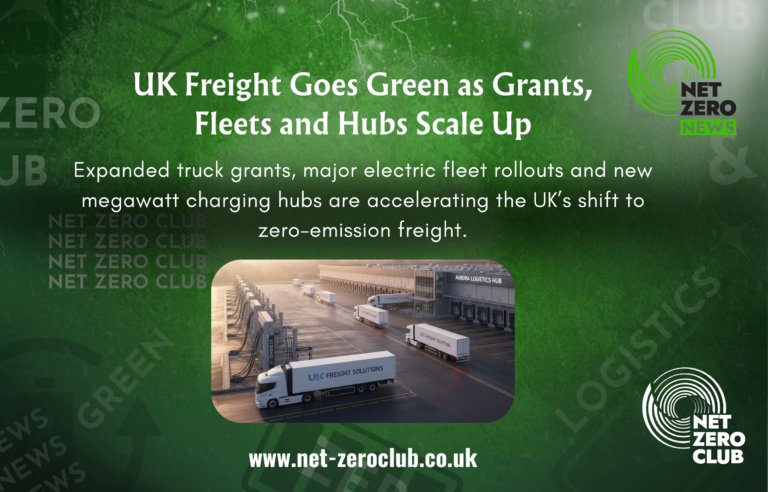
The UK’s logistics and freight sector is accelerating its journey to net‑zero, combining electric heavy goods vehicles (eHGVs), public charging infrastructure, hydrogen trials, and low‑carbon fuels to reduce emissions and meet ambitious decarbonisation targets.
Recent developments highlight the growing shift towards zero‑emission freight. Royal Mail has introduced eight DAF XD 350E eHGVs at its Midlands and North West parcel hubs, supported by ultra‑fast ABB T360 chargers that add up to 60 miles of range in under 15 minutes. These eHGVs are projected to reduce around one thousand tonnes of CO₂ emissions annually while lowering operational costs. Royal Mail joins the Electric Freightway consortium, backed by over £100 million in investment, including significant UK Government support, to build one of the most advanced eHGV charging networks in the UK.
Meanwhile, GRIDSERVE has launched the UK’s first publicly accessible eHGV charging hubs at Extra Baldock and Moto Exeter. Delivered through the Electric Freightway programme, these public depots represent the first of seven expected to open in 2026, enhancing access to high-capacity charging for long‑haul freight operations.
Logistics companies are also deploying their own fleets of electric trucks. Wincanton has begun integrating 24 electric trucks from DAF, Volvo, and Renault into its supply chain fleet, with depot-based charging infrastructure at key sites in Greenford, Portbury, Coatbridge, and Northamptonshire. The move is expected to cut Wincanton’s CO₂ emissions by 2,400 tonnes per year. The initiative is part of the Electric Freightway and eFREIGHT 2030 consortia, under the Zero Emission HGV and Infrastructure Demonstrator (ZEHID) programme, supported by Innovate UK and Department for Transport funding.
In Liverpool, the ZENFreight consortium has deployed its first electric HGV an 8 Volvo FM Electric operating on a closed‑loop FMCG route between a fulfilment centre and Liverpool Port. The depot at Sandhills Business Park includes four charging bays delivering 360 kWh each; the eHGV fully charges in two hours, enabling three to four delivery cycles per day. The programme tests both battery electric and hydrogen fuel cell HGVs, with multiple operators and vehicle manufacturers involved.
Fleet orders are also ramping up. In early 2025, Amazon ordered more than 200 Mercedes‑Benz eActros 600 electric HGVs the largest single electric truck order in UK history to serve its high‑mileage middle‑mile delivery routes. This forms part of Amazon’s broader commitment to achieving net‑zero across its operations by 2040.
The Electric Freightway initiative is already showing strong results: fleets involved have surpassed half a million zero‑emission miles driven, with 79 electric HGVs delivered and 78 more on order exceeding original targets. One of the UK’s largest dedicated eHGV charging depots has been installed at Nissan’s Sunderland plant, featuring ten shared charging bays. The initiative notes that total cost of ownership of eHGVs could reach parity with diesel trucks within five years, especially in high‑use operations, and that lifetime greenhouse gas emissions from electric trucks are up to three times lower than diesel equivalents.
Beyond trucks and charging infrastructure, progress is being made on low‑carbon fuels. DHL Supply Chain is rolling out hydrotreated vegetable oil (HVO) across its UK bunkered sites. This drop‑in renewable fuel, derived from biomass such as used cooking oils and food waste, delivers 80–90 percent carbon savings versus diesel. DHL expects to save around 15,000 tonnes CO₂e through this rollout, providing an immediate, operationally seamless decarbonisation solution while zero‑emission alternatives continue to scale.
Finally, to overcome infrastructure barriers, the UK Government launched the £30 million Depot Charging Scheme, designed to support the installation of over 3,000 van and 200 HGV charge points. Cenex and Energy Saving Trust were appointed to deliver expert support in technical planning, cost benchmarking, and application assistance for fleets and local authorities. The scheme offers reimbursements up to 75 percent of costs, capped at £1 million per applicant, and remains open until funding is exhausted or by 28 November 2025.
What this means:
This wave of activity signals that decarbonisation of UK freight is shifting from pilot stage into operational reality. Companies like Royal Mail, Wincanton, ZENFreight partners, and Amazon are moving forward with eHGV deployments demonstrating that technical and commercial viability is improving. Public‑private collaboration through Electric Freightway, ZEHID consortia, and depot charging grants is building the network and confidence needed to scale.
Infrastructure, especially high‑speed eHGV charging at depots and on‑route hubs, remains critical. Continued grid investment and strategic planning will be essential to enable broader electric truck adoption across long‑haul and regional routes. Low‑carbon fuels like HVO offer the sector an immediate mitigation pathway where electric vehicles are not yet viable. The convergence of electrification, hydrogen trials, and renewable fuels suggests a multi‑modal transition is underway providing flexibility, resilience, and decarbonisation across diverse logistical segments.
In summary, the UK’s freight sector is entering a new chapter: one defined by low‑emission vehicles, expanded infrastructure, and innovative fuel choices powered by government backing and industry leadership.
Upcoming Events:
Net Zero Scotland Projects Conference -16 June 2026, Edinburgh
Net Zero Nations Projects Conference – 6 October 2026, Westminster
Do you have technologies, innovations or solutions that can help public-sector net-zero projects?
Email: lee@net-zero.scot