Got net-zero news, project updates, or product launches to share?
 UK Freight Embraces Zero-Emission Future with Electric HGVs and Charging Hubs

Welcome to Net Zero News, your daily briefing on the UK’s transition to a low‑carbon future.
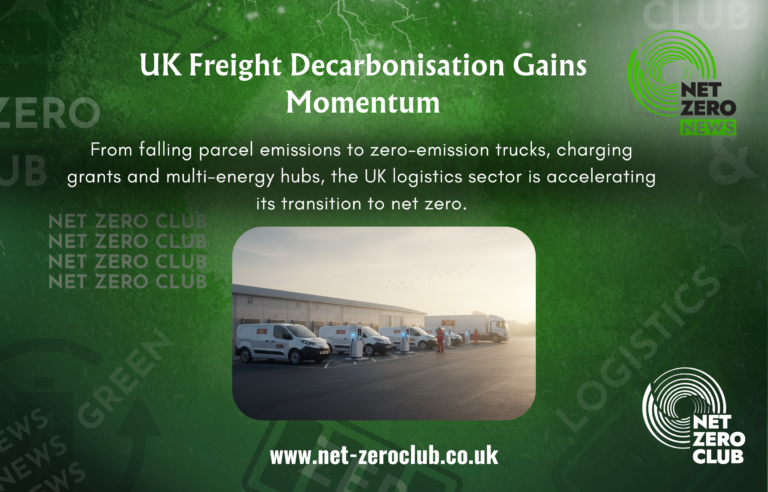
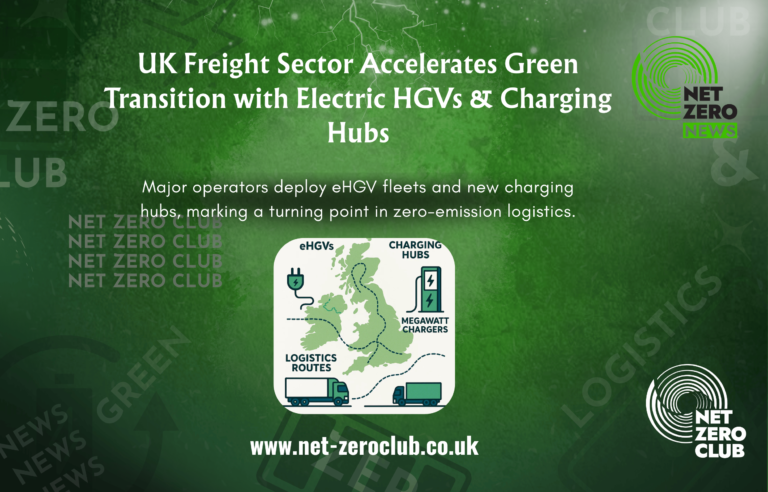
The UK freight and logistics sector is witnessing transformative progress towards net‑zero emissions, driven by ambitious vehicle deployments and groundbreaking charging infrastructure. Royal Mail has introduced eight new DAF XD 350E electric HGVs at its Midlands and North West parcel hubs. These will operate around the clock on middle‑mile routes and will be supported by ABB’s high‑performance chargers that deliver up to 60 miles of range in under 15 minutes. This initiative, backed by over £100 million in investment – including £62.7 million from the UK Government – forms part of the Electric Freightway consortium under the ZEHID programme. The rollout of these vehicles is projected to save approximately 1,000 tonnes of carbon emissions each year and lower operational costs versus diesel alternatives.
Gridserve’s Electric Freightway has also launched the UK’s first public truck charging hubs. Located at motorway service points at Extra Baldock and Moto Exeter, these hubs cater specifically for electric HGVs and represent a major milestone in enabling zero‑emission long‑haul freight. The development is part of the Department for Transport’s ZEHID programme, delivered with Innovate UK.
The ZENFreight consortium made significant headway with its first electric HGV deployment. DFDS has introduced a Volvo FM Electric eHGV operating on a closed‑loop route between Merseyside’s FMCG fulfilment centre and Liverpool Port. The site features high‑capacity charging bays capable of delivering 360 kWh, offering a full charge in two hours and allowing three to four daily delivery cycles.
Logistics specialist FSEW is opening one of Wales’s first low‑carbon freight hubs in Cardiff, powered entirely by renewable energy. Charging infrastructure, including four 400 kW DC chargers managed by Zenobē’s smart charging software, will enable efficient, cost‑effective operations. The hub is scheduled to launch by January 2026 as a flagship low‑carbon site.
Wincanton, a major supply chain operator, has taken delivery of 24 electric trucks supplied by DAF, Volvo, and Renault. These electric HGVs, each over 40 tonnes, are expected to reduce the company’s CO₂ emissions by approximately 2,400 tonnes annually. To support the electrified fleet, the company is rolling out depot‑based charging infrastructure at key sites, including Greenford, Portbury, Scotland Gateway Hub and Northamptonshire, in partnership with Voltempo and Gridserve.
Meanwhile, demand for zero‑emission HGVs is accelerating across the UK. Registration of new zero‑emission HGVs rose 59.1 % in the first half of 2025, although they still represent only around 1 % of total HGV registrations. Nearly 183 units were registered, supported by a growing choice of models – some 35 different zero‑emission options now available. To meet the UK’s target of all new HGVs up to 26 tonnes being zero‑emission by 2035, uptake will need to scale rapidly.
The Scottish Government has responded to this challenge by introducing a £2 million Heavy Goods Vehicle Market Readiness Fund for 2025–26. This fund supports collaboration among HGV operators, manufacturers, financiers and charge point operators to advance HGV decarbonisation and stimulate market readiness. £1 million of the fund is earmarked to assist small and medium‑sized operators, ensuring inclusive access to the net‑zero transition.
What This Means:
The freight sector in the UK is decisively pivoting toward zero‑emission operations. With operational eHGVs, public charging hubs, and low‑carbon freight hubs now materialising, the foundation is being laid for scalable, sustainable logistics. A diverse array of projects from public‑sector support and government programmes to commercial deployments by Royal Mail, DFDS, Wincanton, and FSEW are demonstrating that electric freight is not just viable, but rapidly operational.
The increase in zero‑emission HGV registrations signals growing market confidence, even as uptake remains modest. Infrastructure investments such as those by Gridserve, Voltempo, and the Scottish HGV Fund are tackling the critical barriers of charging access and capital readiness. Encouragingly, the sector’s approach is collaborative and multi‑modal, integrating vehicle technology, energy systems, and policy frameworks.
As the UK strives to hit net‑zero targets by mid‑century, the freight industry is proving its capacity to drive change. Continued public and private collaboration will be essential to scale these early successes across the entire sector.
Upcoming Events:
Net Zero Scotland Projects Conference -3 September 2026, Edinburgh
Net Zero Nations Projects Conference – 6 October 2026, Westminster
Do you have technologies, innovations or solutions that can help public‑sector net‑zero projects?
Email: lee@net-zero.scot