
 Got net-zero news, project updates, or product launches to share?
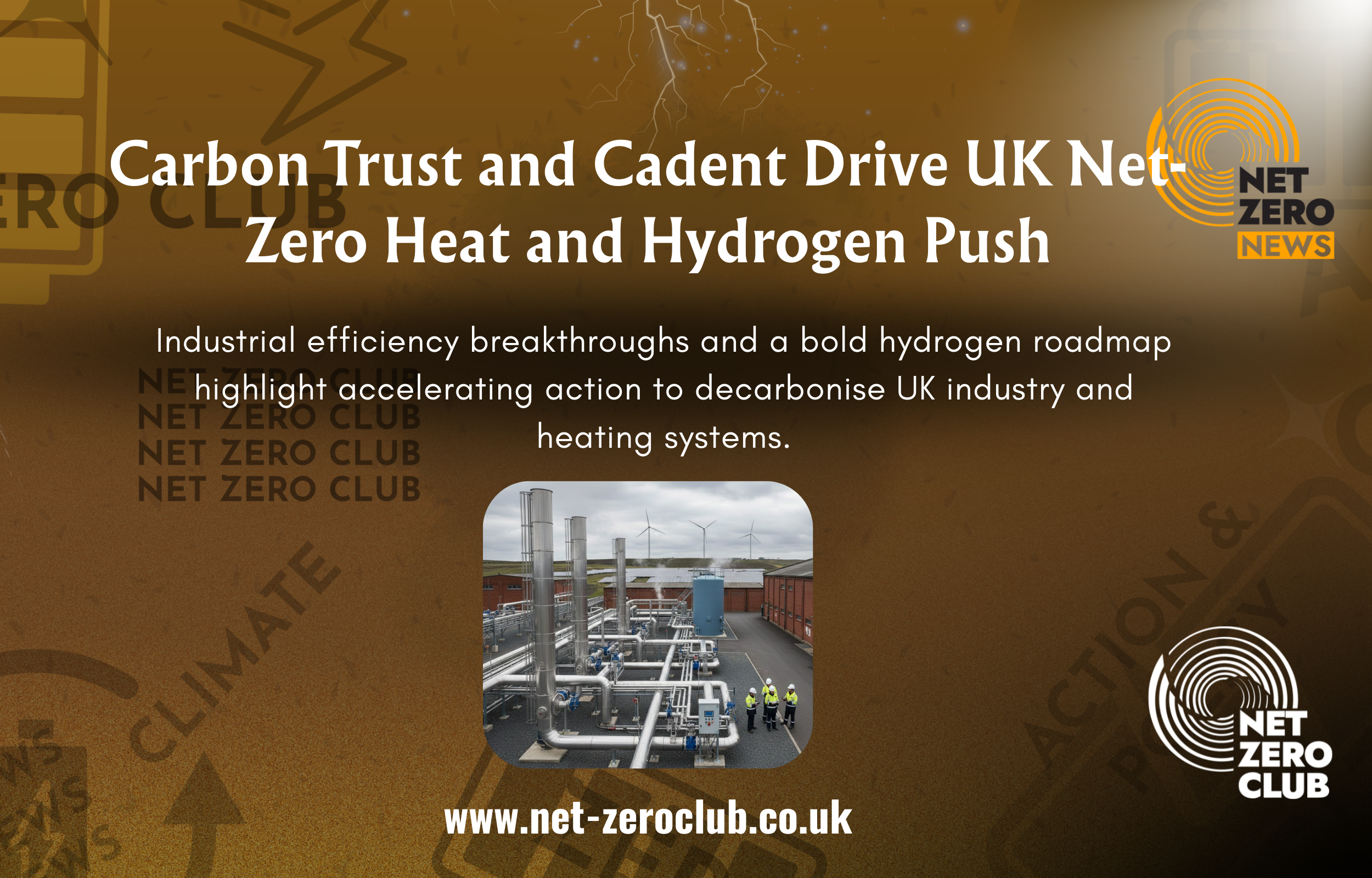
 Carbon Trust and Cadent Propel UK Net Zero Action in Industrial Heat and Hydrogen
Welcome to Net Zero News, your daily briefing on the UK’s transition to a low‑carbon future.
Industrial innovation and hydrogen strategy are at the heart of the UK’s evolving pathway toward net zero, with recent developments demonstrating both ambition and practical progress.
Recent findings from the Carbon Trust’s Industrial Energy Efficiency Accelerator (IEEA) programme highlight the potential of low‑carbon technologies to transform industrial energy use. Thirteen projects across sectors ranging from metalworking to textile recycling have been awarded a total of £7 million in grant funding under phases three and four of the IEEA, demonstrating innovations that could deliver up to 4 million tonnes of CO₂ savings over the next decade. These advances underscore the value of early-stage support in driving scalable industrial decarbonisation while improving resource efficiency.
Meanwhile, Cadent, one of the UK’s largest gas distribution companies, has unveiled a bold 10‑point decarbonisation plan that marks a shift toward hydrogen-based heating. The publicly stated goals include delivering the UK’s first 100 per cent hydrogen pipeline by 2027, launching a hydrogen‑blending facility in 2025, achieving 5 GW of hydrogen production in its region by 2030, creating a hydrogen skills academy and education programme by 2024, installing hydrogen‑ready appliances by 2026, and demonstrating heat decarbonisation for entire communities by 2025.
These initiatives, while distinct in focus, share a common underpinning: they are supported by public funding mechanisms and strategic direction from the Department for Energy Security and Net Zero. The IEEA forms part of the Net Zero Innovation Portfolio (NZIP) and exemplifies how grant funding can accelerate industrial transformation. Equally, Cadent’s hydrogen strategy illustrates a partnership-based approach, requiring both regulatory adaptation and investment in infrastructure and skills.
The two programmes also reflect the broader policy thrust toward tackling the UK’s heat and energy challenges across multiple sectors. Industrial energy use accounts for a sizable portion of emissions, and building-scale emissions particularly from heating are central to the net zero agenda. NJIP-backed innovation, like IEEA projects, enable proof-of-concepts that can be scaled, while hydrogen-based solutions offer pathways to decarbonise heat without full electrification, particularly in challenging contexts.
What this means:
The dual focus on industry and building energy reflects a necessary breadth in the UK’s net zero strategy. Industrial efficiency schemes like IEEA not only advance low-carbon innovation but also prove that modest funding can drive significant long‑term impact. Simultaneously, Cadent’s hydrogen roadmap signals a serious corporate commitment to system-level transformation but success will hinge on coordination across regulators, suppliers and communities.
Together, these developments indicate that the UK’s net zero journey is advancing with both technological experimentation and infrastructure ambition. For policymakers and stakeholders, the challenge now is to sustain funding, align regulation and scale effective models ensuring low-carbon gains in industry and heat become mainstream.
Upcoming Events:
Net Zero Scotland Projects Conference -16 June 2026, Edinburgh
Net Zero Nations Projects Conference – 6 October 2026, Westminster
Do you have technologies, innovations or solutions that can help public‑sector net‑zero projects?
Email: lee@net-zero.scot


