
 Got net-zero news, project updates, or product launches to share?
 UK Freight Sector Accelerates on Green Logistics Front
Welcome to Net Zero News, your daily briefing on the UK’s transition to a low‑carbon future.
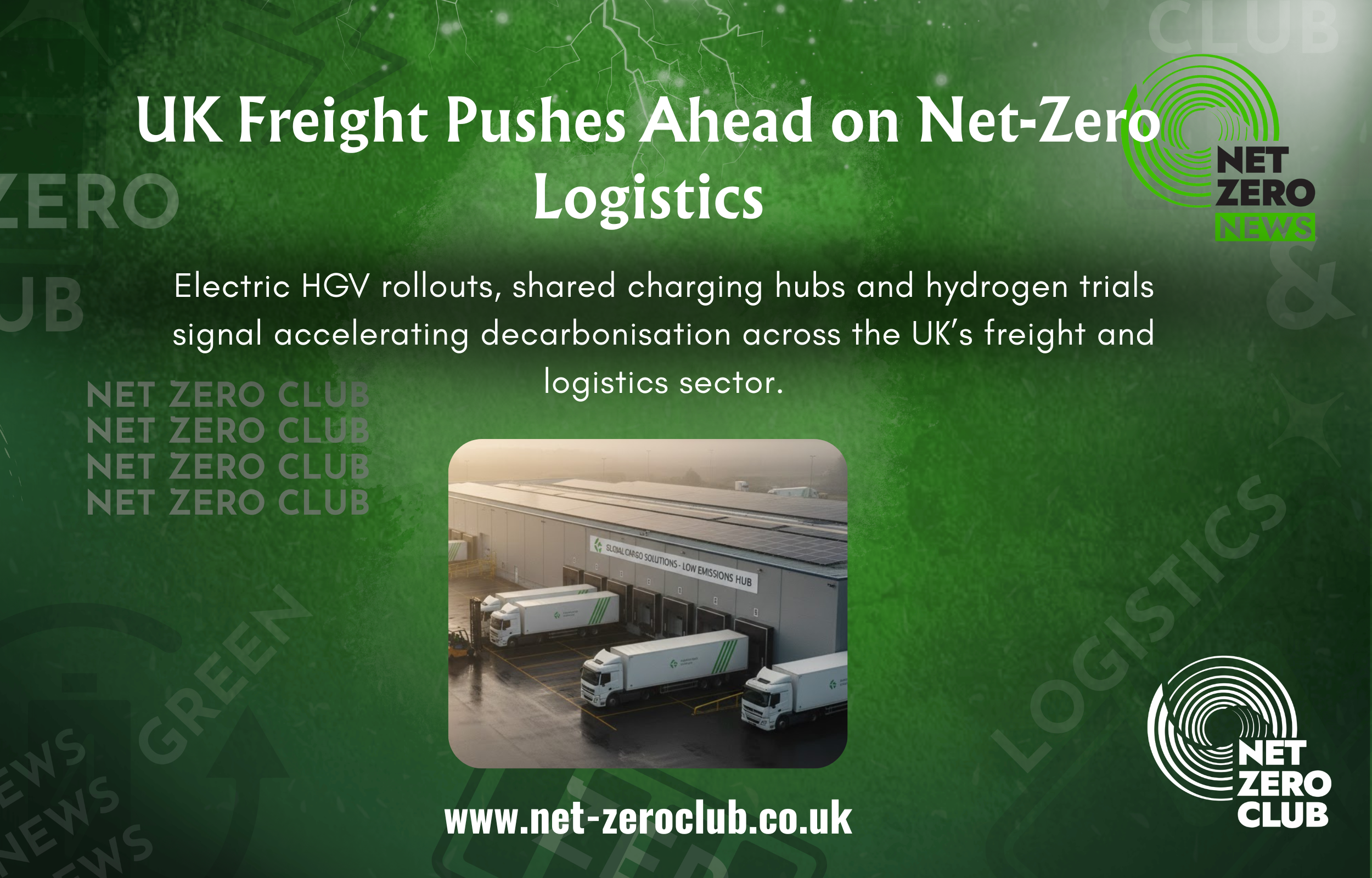
In recent months, the UK’s freight and logistics sector has seen substantive progress in decarbonisation, driven by electric vehicle deployment, climate-focused consortiums and industry-wide collaboration.
Royal Mail has introduced eight DAF battery‑electric 42‑tonne heavy goods vehicles (eHGVs) at its Midlands and North West parcel hubs to replace diesel trucks for middle‑mile operations. These trucks utilise high‑performance fast chargers capable of adding up to 60 miles in under 15 minutes, saving around one thousand tonnes of CO₂ annually while supporting Royal Mail’s net‑zero by 2040 strategy. The company already operates one of the UK’s largest electric delivery fleets, with over 7,000 vans powered by on‑site renewable electricity. This development is part of the Electric Freightway initiative, backed by over £100 million of investment including substantial government support.
Similarly, Wincanton has taken delivery of 24 new electric trucks from DAF, Volvo and Renault, each exceeding 40 tonnes. This represents a key milestone towards its net‑zero by 2040 target. These vehicles are expected to reduce CO₂ emissions by 2,400 tonnes annually. To support these new trucks, depot‑based charging infrastructure is being deployed at multiple locations, developed with Voltempo and Gridserve in conjunction with the Electric Freightway and eFREIGHT 2030 programmes.
In an important infrastructure announcement, the government has revealed the locations of 54 new zero‑emission HGV infrastructure hubs. These sites will support fast charging for electric trucks and hydrogen refuelling, as part of the Zero Emissions HGV and Infrastructure Demonstrator (ZEHID) Programme.
The Electric Freightway programme reports fleets have now exceeded half‑a‑million zero‑emission miles. Across more than 30 partners including Amazon, Royal Mail, GXO and Wincanton, 79 electric HGVs have already been deployed, with another 78 on order. One highlight is a ten‑bay shared charging hub built at Nissan’s Sunderland plant, showcasing scalable high‑capacity solutions. The initiative finds that eHGVs may reach total‑cost‑of‑ownership parity with diesel within five years, with lifetime emissions up to three times lower than conventional trucks.
Hydrogen traction is also progressing: ZENFreight has welcomed John G Russell Transport into its consortium. The company will trial three MAN battery‑electric HGVs alongside three hydrogen fuel‑cell Scania HGVs. They’ll also install depot‑based charging and hydrogen refuelling infrastructure in Coatbridge, near Glasgow. This dual approach enables operators to directly compare EVs and hydrogen fuel‑cell trucks under real‑world conditions.
Meanwhile, the Sustainable Urban Freight Association (SUFA) has launched, bringing together operators ranging from cargo bike fleets to national hubs. Backed by Impact on Urban Health and hosted via a fleet electrification forum, SUFA’s founding members include DHL, DPD, Delivery Mates, Ocado, Pedal Me and others. The association aims to unify urban freight operators to share knowledge, best practices and influence policy to mainstream low‑carbon freight solutions in cities.
Collectively, these developments signal rapid movement across electrification, infrastructure deployment and alternative fuels. What distinguishes this wave is its breadth—from national carriers deploying eHGVs to consortiums trialling comparative technology approaches and urban operators banding together for policy and technical guidance.
What this means:
The UK freight industry is entering a new phase of decarbonisation. Deployment of electric HGVs by major logistics firms not only delivers real emission reductions but also builds operational experience and infrastructure. The Electric Freightway and ZEHID efforts demonstrate that private and public partners can deliver scale and cost feasibility. Hydrogen fuel‑cell trials provide a critical comparative benchmark, particularly for longer‑duty cycles. At the same time, SUFA’s urban‑focused advocacy underscores the importance of inclusive policymaking that supports smaller operators and diverse business models.
The combined effort strengthens the pathway toward net‑zero freight by 2040 advancing not only environmental targets but also commercial viability and resilience across logistics networks.
Upcoming Events:
Net Zero Scotland Projects Conference -16 June 2026, Edinburgh
Net Zero Nations Projects Conference – 6 October 2026, Westminster
Do you have technologies, innovations or solutions that can help public‑sector net‑zero projects?
Email: lee@net‑zero.scot


