Got net-zero news, project updates, or product launches to share?
 UK Freight Sector Accelerates in Green Logistics Innovation

Welcome to Net Zero News, your daily briefing on the UK’s transition to a low‑carbon future.
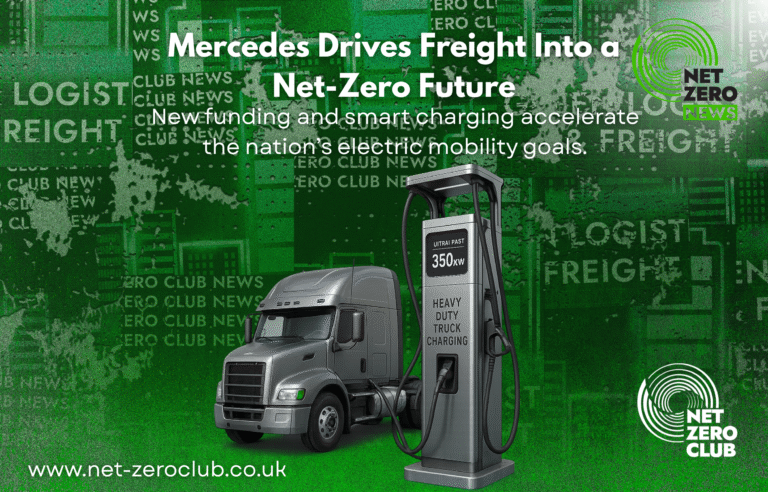
Royal Mail has recently introduced eight DAF XD 350E 42‑tonne electric HGVs at its Midlands and North West parcel hubs, replacing diesel models. These vehicles, supported by ABB T360 high‑performance chargers offering 60 miles of range in under 15 minutes, are expected to eliminate approximately 1,000 tonnes of carbon emissions annually while reducing operational costs. Thanks to its Electric Freightway membership, Royal Mail has deployed high‑speed chargers at Daventry and Warrington, reinforcing its ambition to reach net zero by 2040. The broader Electric Freightway, backed by over £100 million including £62.7 million of UK Government support, is building one of the UK’s largest public eHGV charging networks, with more than 200 chargers delivering up to 350 kW and serving over 140 electric trucks nationwide. This forms part of the ZEHID programme delivered with Innovate UK and supported by up to £200 million of government funding.
Supply chain specialist Wincanton has also made a significant stride, introducing 24 electric trucks from DAF, Volvo and Renault into its fleet. These heavy-duty trucks are estimated to reduce CO₂ emissions by approximately 2,400 tonnes per year. Wincanton is establishing depot-based charging infrastructure across key sites including Greenford, Portbury, Scotland Gateway Hub and Northamptonshire, in collaboration with Voltempo and GRIDSERVE. Participation in Electric Freightway and eFREIGHT2030 as part of ZEHID is helping Wincanton to test and scale net‑zero logistics capacity.
In Cardiff, freight forwarder FSEW is developing one of Wales’s first Low Carbon Freight Hubs, in partnership with Zenobē. Renewable‑powered and equipped with four 400 kW DC chargers (with room to expand), the hub will manage demand through Zenobē’s smart charging software. It will support five Volvo electric trucks and incoming Mercedes-Benz eActros units. FSEW achieved a diesel‑free fleet by the end of 2024, avoiding 2.4 million diesel‑based ‘diesel kms’ and cutting CO₂ by 2,400 tonnes.
The ZENFreight consortium has recently made waves by deploying its first electric HGV under the ZEHID programme. DFDS has brought an Volvo FM Electric eHGV into service at Liverpool’s Sandhills Business Park, where four 360 kWh charging bays allow the truck to complete three to four daily delivery cycles. The project, featuring both battery‑electric and hydrogen fuel cell HGVs, is supported by a £200 million government investment and is a collaboration among firms such as DFDS, John G Russell, Maritime Transport, Gregory Distribution, and academic partner Imperial College London.
Complementing these deployment initiatives, new data from the Society of Motor Manufacturers and Traders shows zero‑emission HGV registrations soared by 59.1 % in the first half of 2025 compared to the prior year, totalling 183 units and capturing about 1 % of the HGV market. Though promising, the SMMT warns that much faster uptake is needed to hit the UK’s zero‑emission target for new HGVs up to 26 tonnes by 2035. Barriers include upfront infrastructure costs and grid connection delays, sometimes as long as 15 years, which must be addressed to scale zero‑emission freight.
Transport and Energy reports that Hitachi ZeroCarbon and GRIDSERVE’s third Electric Freightway milestone reveals over half a million zero‑emission miles driven in the UK. Early data indicates that under certain scenarios, eHGVs can achieve a lower total cost of ownership than diesel equivalents.
Meanwhile, the Sustainable Urban Freight Association (SUFA) has launched to support low‑emission freight in cities across the UK. Backed by health charity funding and offering free membership for its first year, SUFA brings together freight firms using electric vehicles, cargo bikes and multimodal solutions, aiming to influence policy, advance research and facilitate collaboration. Founding members include DHL, DPD, Ocado and others.
What this means:
The UK freight sector is clearly accelerating on multiple fronts: electrification, infrastructure deployment, and emissions reduction. Major operators like Royal Mail, Wincanton, DFDS and others are piloting eHGVs while developing depot charging capacity. Multi‑consortium schemes such as Electric Freightway, eFREIGHT2030 and ZENFreight are catalysing real‑world low carbon logistics. The scale of zero‑emission HGV adoption remains modest, but rising registrations and half a million zero‑emission miles logged reveal momentum.
Challenges remain, particularly around infrastructure investment, grid readiness and the high cost of switching fleets. Strategic support through government funding schemes and regulatory reforms is vital to accelerate decarbonisation. Urban freight is also receiving attention through trade-led initiatives like SUFA, recognising that sustainable last‑mile logistics must feature strongly in net‑zero plans.
Upcoming Events:
Net Zero Scotland Projects Conference -16 June 2026, Edinburgh
Net Zero Nations Projects Conference – 6 October 2026, Westminster
Do you have technologies, innovations or solutions that can help public-sector net-zero projects?
Email: lee@net-zero.scot