Got net-zero news, project updates, or product launches to share?
 UK EV Charging Network Expansion Accelerates Across the Nation
Welcome to Net Zero News, your daily briefing on the UK’s transition to a low‑carbon future.
Public charging infrastructure across the UK continues to expand at an impressive rate. In the first half of 2025, 8,670 new devices were added a 27% increase year‑on‑year bringing the network to over 82,300 units across 40,479 locations. Rapid and ultra‑rapid «charging hubs», defined as six or more high‑power chargers in one location, are proliferating too, with 136 newly opened this period, raising the total to 673. Notable additions include Osprey Charging’s 24 ultra‑rapid points in Merseyside, Be.EV’s installation at Greater Manchester, Source’s hub in Edinburgh, RAW Charging at Stourhead, and Be.EV’s Manchester Oasis on a former petrol site. Ultra‑rapid devices (150 kW+) accounted for 18% of all installations, now outnumbering rapid units .
The pace did not slow. By Q3 2025, a further 3,928 units were delivered, raising the total to over 86,000 across 43,500 locationsa 22% year‑on‑year surge. Ultra‑rapid chargers jumped 51% compared to September 2024, and 212 charging hubs were created over the past year. Be.EV unveiled an ultra‑rapid charging network investment, while Zest, Osprey, and partnerships between Extra MSA and IONITY expanded capacity at key motorway service areas. Regions such as the North West, Yorkshire & Humber, the South‑East, and Wales saw strong growth in high‑powered chargers. A collaboration between Zest and the North East Combined Authority delivered 40 ultra‑rapid spaces across 18 selected sites, including country parks and leisure centres. Destination locations like supermarkets are increasingly offering rapid or ultra‑rapid charging 60% of new supermarket EV sites now do so. Still, sub‑50 kW chargers remain the largest share (~80%). On‑street infrastructure grew robustly outside London, up 31% year‑on‑year .
By early April 2025, 3,141 more devices had been deployed, taking the tally to nearly 76,840 a 29% increase year‑on‑year. Charging hubs grew by 49 in Q1, reaching a total of 586. On‑street chargers increased most significantly outside London, which saw modest expansion of just over 5.6%, contrasted by more than 13% growth elsewhere. Projects under the LEVI fund gained traction, with Midlands Connect securing over £40 million to deliver more than 16,000 chargers across 13 local authorities. Certain regions like the East of England and West Midlands saw over 44%‑46% expansion in charging capacity, while Northern Ireland surged in ultra‑rapid devices by 63% year‑to‑date .
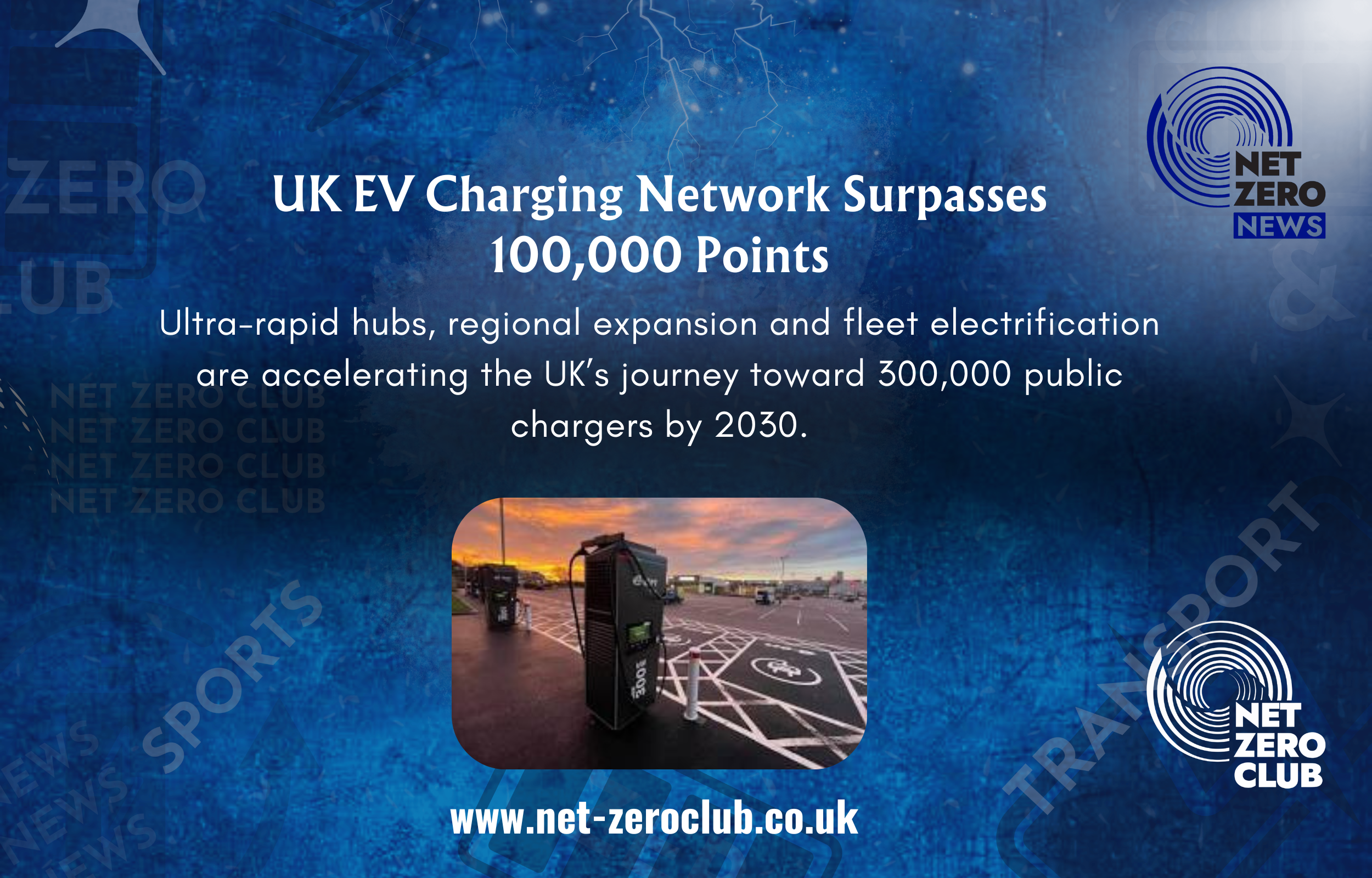
The total number of public chargers surpassed 100,000 by April 2025, with one new charger being added around every 13 minutes. Rapid and ultra‑rapid units now account for about 24% of all public chargers propelled by government reaffirmation of the 2030 ICE phase‑out and a target of 300,000 public chargers by then. Earlier, in March 2025, the network had already climbed past 75,000 devices, representing a 32% increase over the preceding year. Ultra‑rapid adoption had grown by 84% in 2024 alone, demonstrating their growing importance in public charging strategy .
On the public‑sector fleet front, fleet electrification continues to gain ground. National Highways has ordered 18 Proace Electric vans and 40 bZ4X SUVs from Toyota, reinforcing its pledge to become net zero in corporate emissions by 2030. Meanwhile, Denbighshire County Council is trialling the UK’s first AC‑based vehicle‑to‑grid (V2G) chargers in a fleet depot under the V2VNY project. This initiative explores how AC V2G infrastructure may lower energy costs and bolster grid resilience.
Other innovations include Hitachi ZeroCarbon’s launch of an all‑in‑one EV fleet management platform, offering charging management, battery optimisation, and financing tools to support intelligent fleet electrification planning amid new zero‑emission regulations by 2035. Similarly, Dynamon has developed an AI‑powered decarbonisation report, enabling fleets to transition more affordably and effectively by optimising vehicle selection, route planning, and depot charging needs delivered in just days.
A new yellow paper from AA Business Services Bridge to EV: Creating Business Confidence offers practical guidance for fleets still using ICE vehicles. It provides a roadmap to reduce carbon impacts, dispel EV myths, and build confidence in electrification strategy.
Lastly, disparities in local authority fleet electrification persist. Geotab’s FOI‑based data reveals a sharp gap: Bristol leads with 44.5% EVs in its fleet, followed by Liverpool (43.3%), Leeds (27.8%), Manchester (26.8%), Glasgow (25.8%), and Edinburgh (22.6%). Yet Transport for London trails significantly at just 3.2%.
What this means:
The UK’s EV infrastructure is growing both in scale and sophistication, with rapid and ultra‑rapid chargers spreading even beyond traditional strongholds. Public and private fleets are embracing electrification strategies backed by AI tools and evolving policy targets. Innovation in depot charging including AC Vehicle‑to‑Grid signals a maturing market that increasingly integrates energy management and transport decarbonisation.
Upcoming Events:
Net Zero Scotland Projects Conference -3 September 2026, Edinburgh
Net Zero Nations Projects Conference – 6 October 2026, Westminster
Do you have technologies, innovations or solutions that can help public‑sector net‑zero projects? Email: lee@net‑zero.scot