Got net-zero news, project updates, or product launches to share?
 UK Accelerates Net‑Zero Transport with Fleet Charging and Ultra‑Rapid Infrastructure
Welcome to Net Zero News, your daily briefing on the UK’s transition to a low‑carbon future.
In recent months, the UK has seen significant progress in decarbonising transport through new infrastructure, fleet electrification and supportive schemes, signalling strong momentum toward achieving net‑zero emissions.
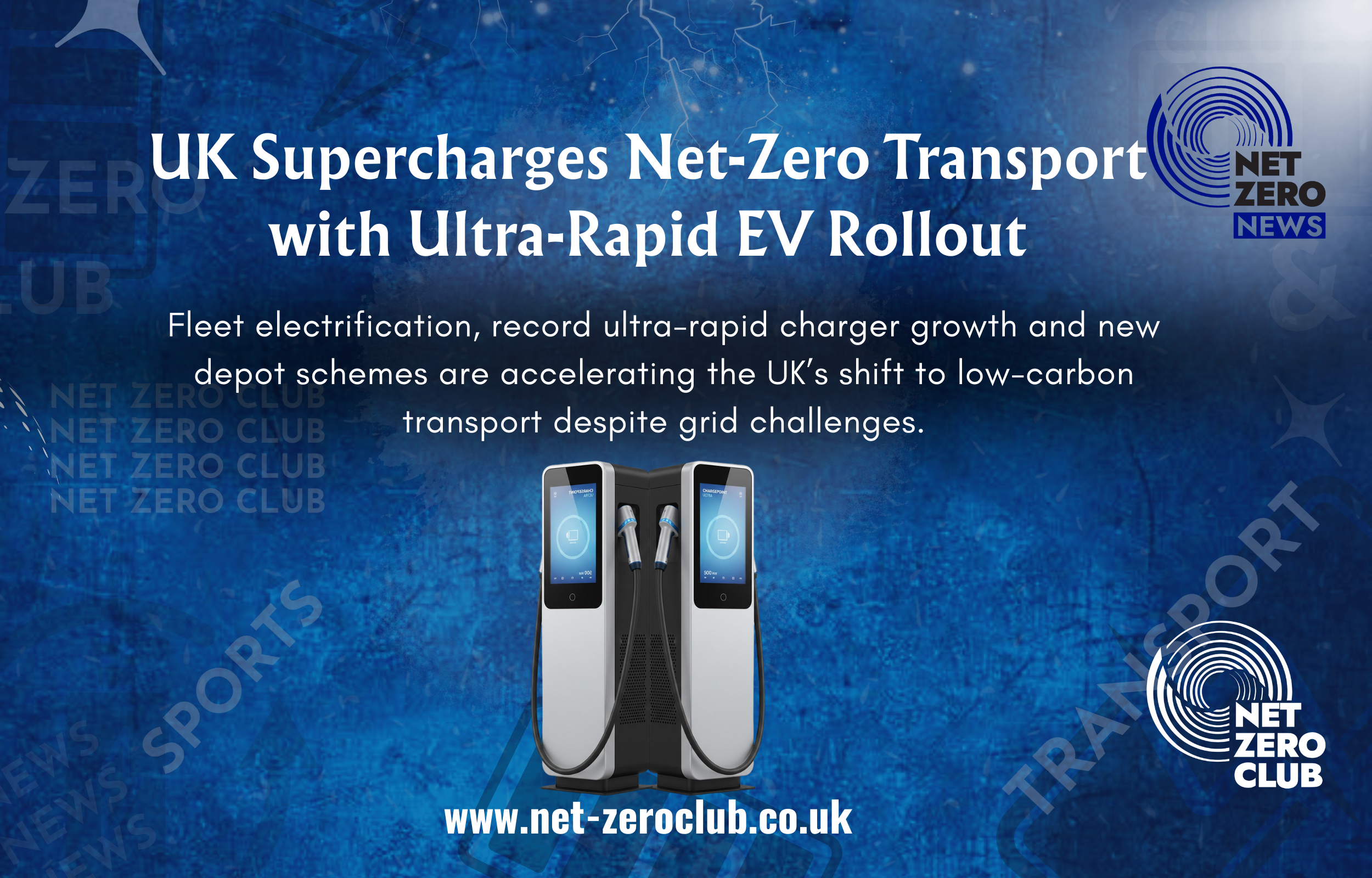
A landmark expansion in public charging has continued. By the end of October 2025, the UK hosted 86,798 charging devices across 44,142 locations, including 378 net‑new rapid or ultra‑rapid units in that month alone. Ultra‑rapid chargers (150 kW+) saw a remarkable 49% year‑on‑year growth over the past 12 months. London remains the area with the highest number of charge points, followed by the South East and West Midlands. The number of public charging hubs (sites with at least six rapid or ultra‑rapid chargers) rose 31% since the end of 2024, reaching 705 by October 2025. InstaVolt, Tesla and Osprey now lead rapid and ultra‑rapid charger deployments nationwide.
Earlier in 2025, installations surged even further. In Q1 alone, 3,141 new charge points were added, increasing the national total to 76,840 a 29% annual rise. During the same quarter, ultra‑rapid device numbers soared by nearly 66% to 7,726. New charging hubs also came online, bringing the total hubs in the UK to 586.
Across the first half of 2025, 8,670 new charge points came online a 27% year‑on‑year increase raising the total to around 82,369 devices spread across more than 40,000 locations. Installations of ultra‑rapid devices rose nearly 23%, totaling 8,619, and for the first time outnumbered rapid chargers. Regional growth is widespread; Scotland recorded a 29% uplift in high‑powered chargers, while the North West saw 21% growth.
Fleet electrification is also gaining pace. Marks & Spencer added 85 zero or low‑emission vehicles to its logistics fleet including five battery‑electric HGVs serving stores in London and the South East—as part of the eFREIGHT 2030 demonstrator to inform future planning. Transport for London confirmed that over 2,000 zero‑emission buses, approximately 20% of its fleet, are now operating on London routes. TfL aims to fully electrify its fleet by 2030, a change expected to save an estimated five million tonnes of CO₂ over two decades.
Innovative charging infrastructure continues to emerge. First Charge’s depot charging service has been made available via the Allstar EV network, offering low‑cost, high‑powered depot charging across multiple secure locations. Similarly, First Bus has opened access to 11 ultra‑rapid depot charging locations (150‑350 kW) for third‑party fleets through its Paua Share scheme, boosting infrastructure utilisation and fleet flexibility.
In the freight sector, Fleete has broken ground on the UK’s largest dedicated charging hub for electric HGVs at the Port of Tilbury. Scheduled to open by December 2025, this 5 MW shared‑user facility will support 16 rapid chargers, enabling high‑volume commercial operations around the clock. FSEW and Zenobē are developing Wales’ first low‑carbon freight hub powered entirely by renewables, with four 400 kW DC chargers and smart systems to support electric trucks, pushing decarbonisation in heavy freight.
Government support is starting to land. A £30 million Depot Charging Scheme was launched on 16 July 2025 to fund up to 75% of charger installation costs for vans, HGVs and coaches, potentially delivering over 3,000 van and 200 HGV charge points. This is part of a wider £63 million EV infrastructure package administered by Cenex and the Energy Saving Trust.
Despite positive momentum, challenges remain: depot connection delays could stretch up to 15 years under current grid processes well past the deadlines for phasing out non‑zero‑emission commercial vehicles. The industry calls for grid planning reform, prioritised connection access and energy cost considerations to avoid bottlenecks in fleet electrification.
What this means:
The UK is clearly accelerating toward net‑zero transport. Rapid network expansions, new depot models and high‑power hubs are supporting both public and commercial fleets. Government investment ensures more actors can participate in electrification. However, infrastructure bottlenecks, particularly around grid connections, pose a serious risk. Delivering on net‑zero goals will require smarter planning, stronger coordination between power and transport sectors, and continued policy support.
Upcoming Events:
Net Zero Scotland Projects Conference -16 June 2026, Edinburgh
Net Zero Nations Projects Conference – 6 October 2026, Westminster
Do you have technologies, innovations or solutions that can help public-sector net-zero projects?
Email: lee@net-zero.scot