Got net-zero news, project updates, or product launches to share?
 Transport Transformation: Hydrogen, HGVs and EV Charging Surge

Welcome to Net Zero News, your daily briefing on the UK’s transition to a low-carbon future.
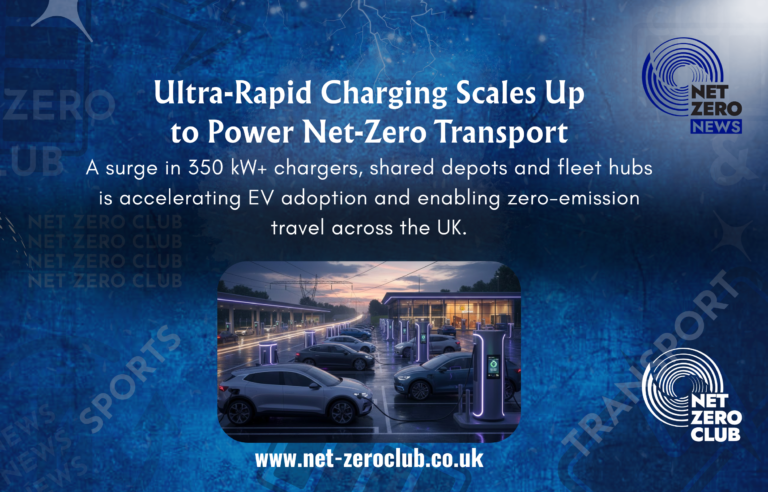
The UK’s path toward net-zero transport is gaining momentum, showcasing remarkable advancements in charging infrastructure, hydrogen innovation, and clean heavy goods vehicle deployment. In the realm of EV infrastructure, the first half of 2025 saw the installation of 8,670 new public charge points an increase of 27% compared to the same period in 2024. This expansion has boosted the total to 82,369 devices across 40,479 locations, with ultra-rapid chargers now accounting for 18% of all installations and surpassing standard rapid chargers for the first time. Charging hubs sites equipped with six or more rapid or ultra-rapid chargers now number 673 nationwide.
Building on previous milestones, the UK had already surpassed 75,000 public charge points by February 2025, representing a 32% year-on-year rise. Ultra-rapid charging has driven this growth, with both en-route and destination charging provision expanding across motorways, hotels, and residential streets alike. Another significant achievement came in April 2025, when public charger installations crossed the 100,000 mark nearly one new charger every 13 minutes across the UK. Rapid and ultra-rapid devices now comprise about 24% of the total, testament to drivers’ growing demand for faster charging options.
Hydrogen innovation is also gaining traction. In February 2026, GeoPura was selected to supply green hydrogen for the Lower Thames Crossing project—the first major UK infrastructure scheme aiming to be carbon neutral during construction. GeoPura will deliver 2,500 tonnes of hydrogen, replacing over 12 million litres of diesel and cutting emissions by an estimated 30,000 tonnes of CO₂. On-site hydrogen-powered generators and the UK’s first hydrogen-fuelled JCB digger are already being deployed to support low-carbon construction activity.
The heavy goods vehicle sector is beginning its electrified transformation. In October 2025, the ZENFreight consortium launched its first electric HGV Volvo FM Electric on a closed-loop route between a fulfilment centre and Liverpool port. The accompanying charging facility offers four 360 kWh bays, each enabling a full charge in two hours, facilitating up to four daily delivery cycles. This pilot sets the stage for network-wide deployment under the Zero Emission HGV and Infrastructure Demonstrator (ZEHID) programme.
However, not all hydrogen-focused initiatives have succeeded. The HyHaul project also part of ZEHID has been terminated following insufficient commercial interest in hydrogen fuel cell HGVs. Although progress was made in several areas, the project failed to meet targets for customer acquisition and fleet commitments, prompting funders to withdraw support. This development highlights ongoing barriers to hydrogen adoption in road freight, even amid broader industry optimism.
What this means:
The acceleration of EV charging infrastructure from residential streets to ultra-rapid en-route hubs is transforming accessibility for drivers and underpinning confidence in electric mobility. Simultaneously, hydrogen is emerging as a viable low-carbon energy source for heavy-duty transport and construction, with projects like the Lower Thames Crossing and ZENFreight demonstrating real-world deployment. While challenges remain illustrated by HyHaul’s closure the progress across multiple transport modes signals an integrated and evolving strategy to decarbonise the UK’s transport system.
Upcoming Events:
Net Zero Scotland Projects Conference -16 June 2026, Edinburgh
Net Zero Nations Projects Conference – 6 October 2026, Westminster
Do you have technologies, innovations or solutions that can help public-sector net-zero projects?
Email: lee@net-zero.scot