Got net-zero news, project updates, or product launches to share?
 Net Zero News: Royal Mail rolls out EV eHGV fleet for net-zero
Welcome to Net Zero News, where we bring you the latest developments driving the UK’s transition to a net-zero future.
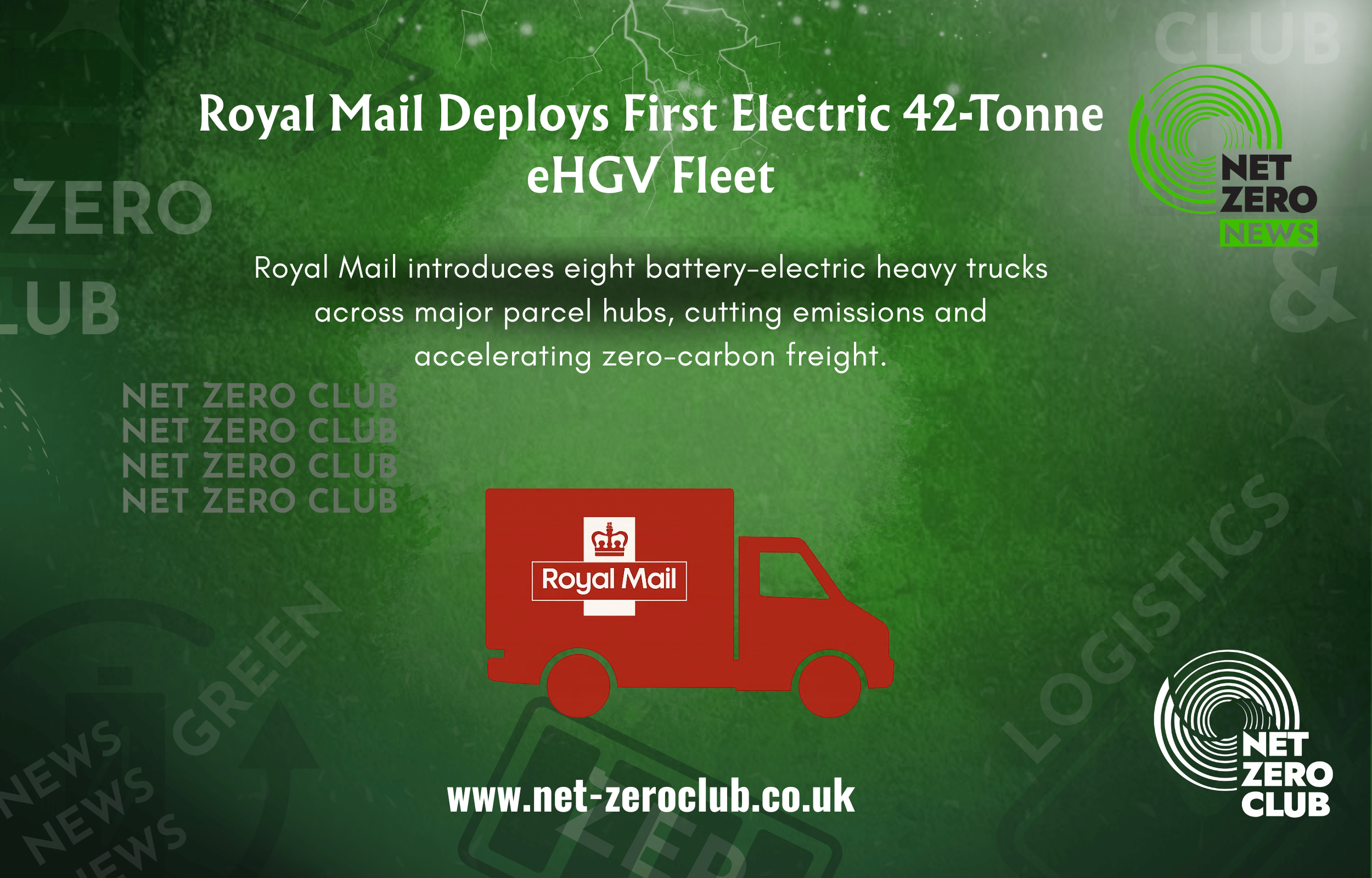
Net Zero News can reveal that Royal Mail has introduced its first eight battery-electric heavy goods vehicles at parcel hubs in the Midlands and the North West. The rollout took place in December 2025, marking a decisive move by the national postal operator to replace its diesel-powered 42-tonne trucks with zero-emission alternatives.
The eight new vehicles are DAF 42-tonne XD 350E electric HGVs, each configured to undertake ‘middle-mile’ operations—shuttling parcels between regional sorting centres and local mail hubs. These trucks will run around the clock, maintaining the high throughput required for Royal Mail’s network, while eliminating tailpipe emissions on traditionally diesel-dependent routes.
This deployment forms the first phase in transitioning Royal Mail’s heavy-duty fleet to electric power. By choosing the DAF XD 350E platform, the operator is adopting technology designed to deliver the torque and payload capacity of conventional diesel trucks, but powered entirely by on-board batteries. The vehicles do not emit nitrogen oxides or particulate matter during operation, offering immediate air quality benefits in urban and suburban areas.
In a significant step towards the UK’s net-zero goals, this initiative addresses one of the more challenging segments of transport decarbonisation. Freight movements remain a substantial contributor to logistics emissions, and ‘middle-mile’ haulage is critical to the end-to-end efficiency of parcel delivery. Electrifying these routes can substantially reduce the carbon footprint of last-mile services, which have seen rising demand amid the growth of e-commerce.
The environmental advantages are clear: each zero-emission truck displaces the diesel consumption of its predecessor, cutting CO2 emissions by an estimated 50 tonnes per vehicle each year, based on average mileage. In addition, local communities stand to benefit from reduced noise and improved air quality along busy freight corridors.
Royal Mail has collaborated with DAF Trucks to secure the XD 350E models, with maintenance and support agreements aligned to ensure uptime across its network. While no direct public subsidy has been announced for this first batch, industry observers note that the vehicles may qualify for existing UK grants aimed at vehicle electrification. The partnership underscores the private sector’s role in deploying zero-emission technology at scale.
This rollout aligns with the UK Government’s legally binding target to achieve net-zero greenhouse gas emissions by 2050, as set out in the Climate Change Act 2008 (2050 Target Amendment) Order. It also dovetails with strategies published under the Transport Decarbonisation Plan, which identified freight electrification as a priority to meet interim carbon budgets and support cleaner air objectives.
The introduction of electric HGVs at major parcel hubs promises broader benefits for the logistics sector. Fleet managers will gain operational insights into charging schedules and total cost of ownership, information critical to expanding zero-emission heavy vehicle use. Meanwhile, electric infrastructure providers may see increased demand for high-capacity chargers at industrial estates and distribution parks.
Looking ahead, Royal Mail plans to monitor vehicle performance and operational costs over the coming months, with a view to scaling up its electric fleet. Milestones include integration with on-site renewable energy sources and the exploration of bi-directional charging to maximise energy efficiency.
Net Zero News is powered by the Net Zero Club.
Join the UK’s fastest-growing net-zero community.
Upcoming Events:
Net Zero Scotland Projects Conference – Edinburgh
Net Zero Nations Projects Conference – Westminster, London
Got a net-zero project to share? Email: lee@net-zero.scot