Got net-zero news, project updates, or product launches to share?
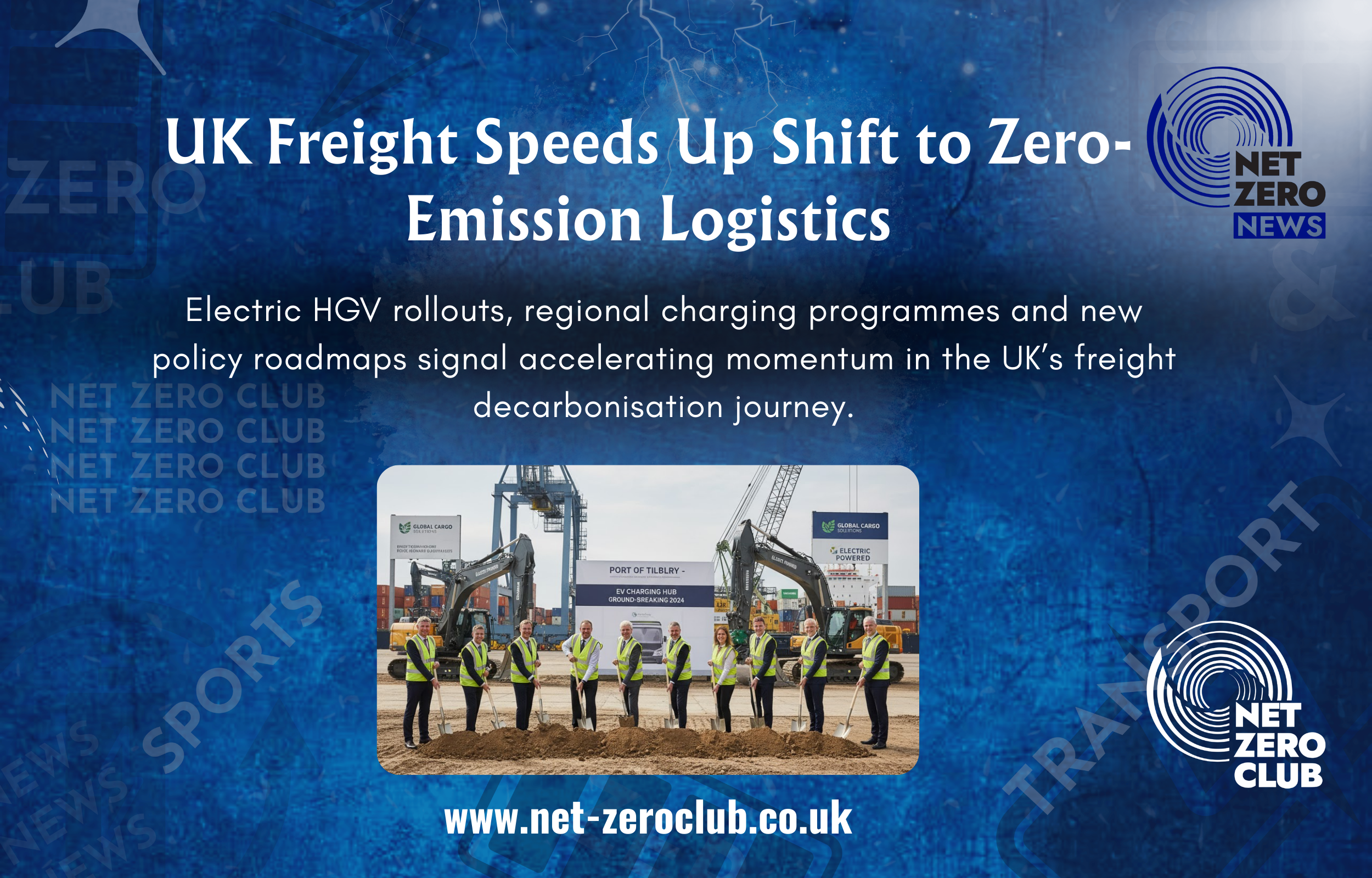
 Fleete Breaks Ground at Port of Tilbury, Charging Hub Marks Major Net‑Zero Transport Advancement
Welcome to Net Zero News, your daily briefing on the UK’s transition to a low‑carbon future.
Fleete, a leading charging solutions firm, has officially broken ground on a flagship electric vehicle (EV) charging hub for commercial vehicles at the Port of Tilbury in Essex. The site will host a 5‑megawatt shared‑user facility, strategically designed to accelerate decarbonisation in the logistics and freight sectors. This initiative is partially funded with £1 million from the UK government’s Thames Freeport seed capital programme and is one of the largest dedicated HGV charging infrastructure projects in the UK. Key stakeholders including the Mayor of Thurrock gathered to witness this milestone. The hub will come online in December 2025 and feature 16 rapid chargers capable of simultaneously serving large fleet operations, showcasing the strength of public‑private collaboration in building sustainable transport infrastructure.
The development of this 5 MW hub is poised to address persistent challenges in fleet electrification by offering high‑capacity, dependable charging services in a major multimodal logistics hub. Twelve chargers will be supplied by Heliox and four by Voltempo under the eFREIGHT 2030 project. Intelligent energy management systems will ensure equitable grid capacity sharing among Port of Tilbury tenants. This infrastructure is expected to provide essential support for zero‑emission freight corridors across the Thames estuary and beyond.
Local and national leaders emphasised its significance in aligning economic and environmental goals. Fleete’s CEO described the ground‑breaking as more than a construction milestone it demonstrated how government seed funding can catalyse private investment in net‑zero infrastructure. A minister for local growth highlighted how the hub demonstrates Thames Freeport’s green transport vision while boosting regional job creation. The Thames Freeport CEO added that this hub exemplifies the Freeport concept unlocking investment and innovation through sustainable infrastructure for economic development.
This project joins a broader wave of EV charging infrastructure expansion across the UK. For example, InstaVolt reached its 2,000th ultra‑rapid charger, aiming for 11,000 chargers by 2030, reflecting rapid network growth, particularly in underserved urban and commuter areas. Concurrently, DPD has partnered with bp pulse to expand charging at its depots currently hosting nearly 4,000 EVs or over 35 percent of its van fleet, and with plans to scale further as part of its validated net‑zero by 2040 strategy.
The FMCG sector is also seeing innovation: Denbighshire County Council is trialling an AC vehicle‑to‑grid (V2G) charging system at its depot. The installation integrates solar generation, battery storage, and smart controls, offering cost savings, grid resilience and emission reductions. It exemplifies how fleets can act as flexible energy assets rather than just consumers. Meanwhile, Transport for London (TfL) has used Dynamon’s fleet optimisation software to reveal that half its engineering‑service support vehicles are ready for immediate electrification, without changes to schedules or routes streamlining the transition.These infrastructure developments and innovations come amid acute industry concerns over grid constraints: a recent report by the Society of Motor Manufacturers and Traders (SMMT) warns that depot charging applications face potential wait times of up to 15 years well beyond deadlines for fleet decarbonisation. It emphasises the urgent need for planning reform, prioritised grid access and energy‑cost interventions to unlock net‑zero freight. Similarly, Zemo Partnership has convened a policy forum to map ‘missing policies’ in the UK’s net‑zero transport plan and will publish findings in June, aiming to strengthen integration across energy, planning, industry and skills policies.
Taken together, these developments signal a critical shift: commercial fleet electrification is gaining real‑world momentum. High‑capacity infrastructure projects like the Port of Tilbury EV hub, innovative solutions like V2G and intelligent fleet analytics, and growing charging networks are converging to scale emission reductions. However, the full potential can only be realised if systemic barriers grid bottlenecks, policy gaps and slow planning are addressed with urgency.
What this means:
The opening of Fleete’s Port of Tilbury charging hub will help decarbonise freight by providing essential infrastructure, but its success depends on broader systemic reforms. Without faster grid connections and integrated policy support, other EV charging projects may falter. Accelerated depot conversion at TfL and energy‑dynamic innovations like V2G offer promising direction. Policymakers need to prioritise grid access, streamline deployment and fill regulatory gaps to build on these new investments and unlock net‑zero transport at scale.
Upcoming Events:
Net Zero Scotland Projects Conference -16 June 2026, Edinburgh
Net Zero Nations Projects Conference – 6 October 2026, Westminster
Do you have technologies, innovations or solutions that can help public-sector net-zero projects?
Email: lee@net-zero.scot